
Accessible door hardware.
What the Equality Act 2010, Approved Document M and BS 8300-2:2018 mean for door furniture specifiers.
From the DDA to the Equality Act 2010
The Disability Discrimination Act 1995 (DDA) was repealed and replaced by the Equality Act 2010 in October 2010. While many architects and specifiers still refer to "DDA compliance", the current legal framework in England, Scotland and Wales is the Equality Act, supported by Approved Document M (Volume 2) of the Building Regulations and the British Standard BS 8300-2:2018.
This page is the canonical Ash reference for what those statutes actually require of door hardware — pull handles, lever handles, push plates, kick plates, panic bars and thumbturn locks — and what we manufacture to satisfy them.
Standards governing accessible door hardware.
Four instruments together define what is legally and technically required. They overlap deliberately — the Equality Act creates the duty, Approved Document M provides the regulatory baseline, and the British Standards tell you how to actually build to it.
Equality Act 2010
Places a continuing duty on service providers, employers and education bodies to make "reasonable adjustments" to physical features — including door furniture — where they place a disabled person at a substantial disadvantage. The duty is anticipatory: it applies before a disabled user ever arrives.
For door hardware, this means specifying handles, plates and panic devices that an adult of average build with limited dexterity, reduced strength, a closed fist or a visual impairment can operate without difficulty.
Sections 20-22, Schedule 2Approved Document M, Vol. 2
The statutory guidance for "Buildings other than dwellings" — the document Building Control inspectors will measure your scheme against. It mandates that doors on accessible routes are operable with one hand using a closed fist, and that the opening force does not exceed 30N (0–30°) and 22.5N (30–60°).
Handles must be clearly visible against the door, mounted at an accessible height, and located at the leading edge of double doors.
Para 2.17 – 2.21BS 8300-2:2018
The practical reference for an inclusive built environment. Section 9 deals specifically with doors, door furniture and door operation. Defines pull handle diameter (19–35 mm), clearance from door face (45 mm minimum), mounting heights, LRV contrast requirement (≥30 points) and material thermal performance for external handles.
This is the document architects cite in specifications. It is what Ash designs every standard product to.
Section 9.1 – 9.3BS EN 1125
The European standard for panic exit devices operated by a horizontal bar — mandatory on emergency escape routes used by the general public. Specifies maximum operating force (80N), durability (100,000 cycles for Grade 7), and that release must function under a 1,000N pre-load on the door.
Where the door is used by trained staff only, BS EN 179 (emergency exit) applies instead.
EN 1125:2008 + A1:2024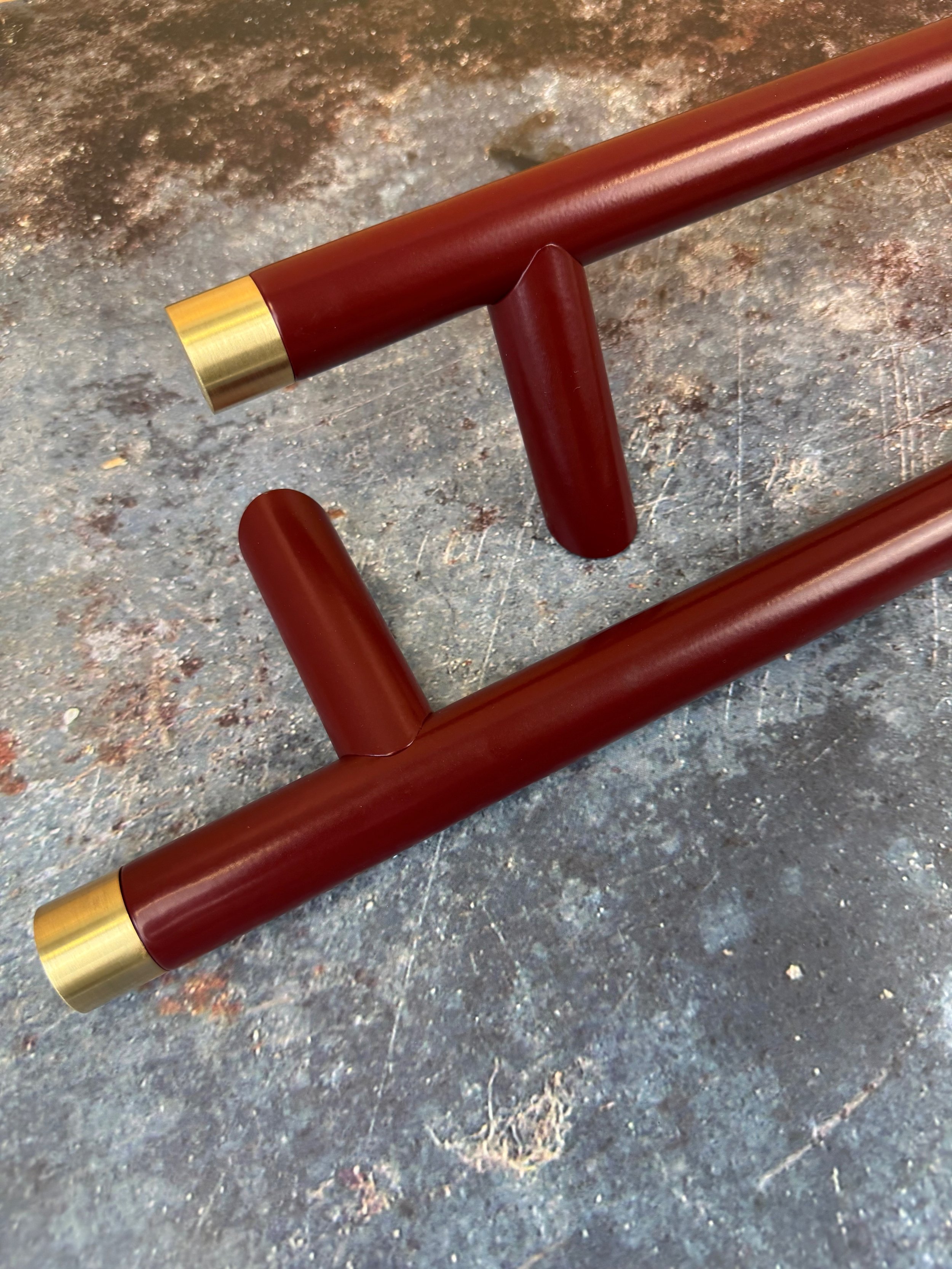
Compliant specification by element.
A working reference for every element of door furniture you will specify on an accessible route. Numerical values are drawn from BS 8300-2:2018 and Approved Document M (Vol. 2). Use as a starting point and confirm against the latest published edition for your project.
| Element | Compliant specification | Operating force | Visual contrast | Governing standard |
|---|---|---|---|---|
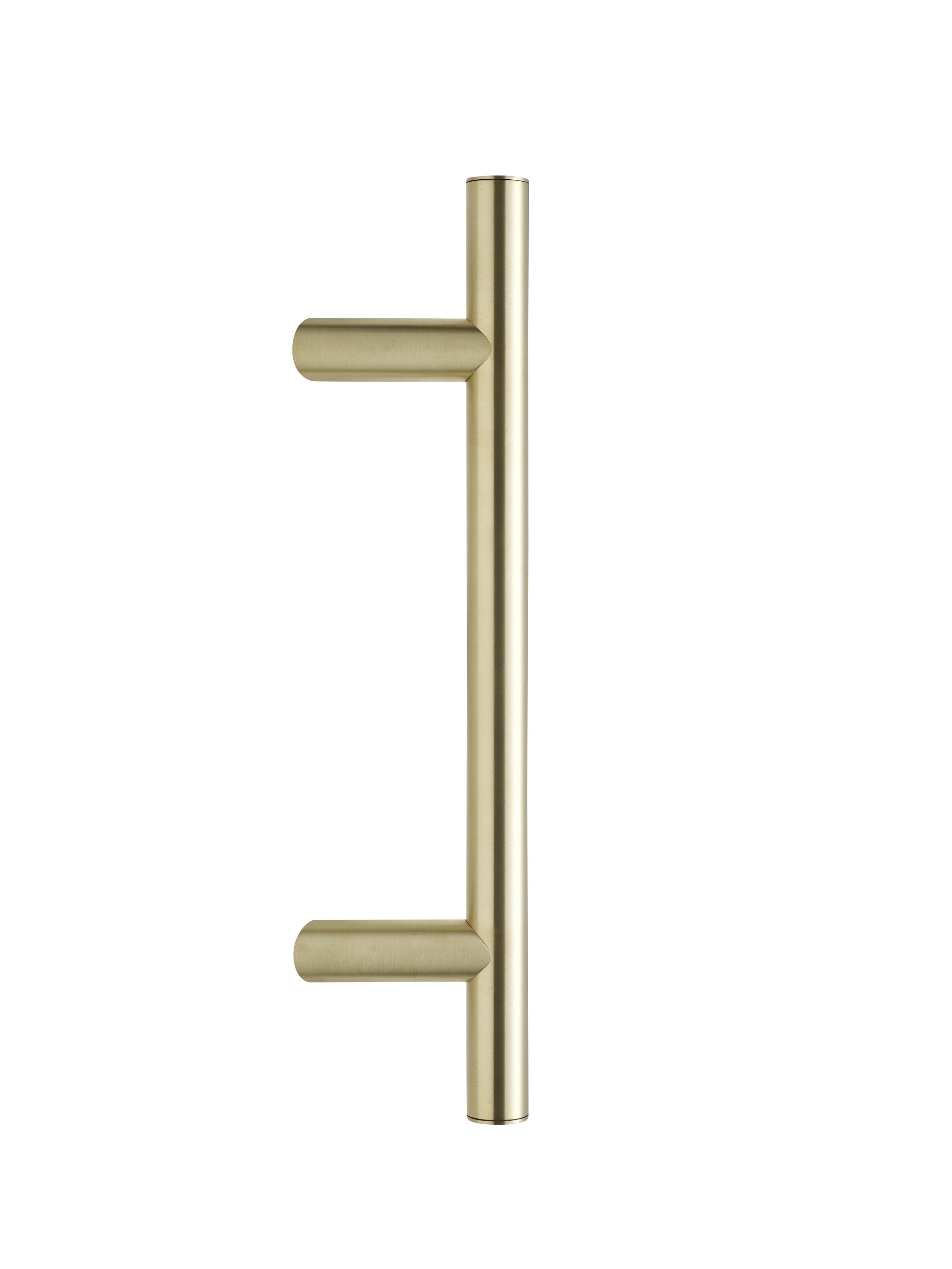
| Pull handles | Diameter 19–35 mm; clearance from door face ≥45 mm; vertical handle no higher than 1000 mm AFFL; minimum overall length 800 mm. | ≤30N initial / ≤22.5N through swing | ≥30 pt LRV difference from door | BS 8300 · ADM 2.17 |
| Lever handles | Lever return to within 25 mm of the door face; centred at 900–1100 mm AFFL; not knob-set on accessible routes. | ≤20N torque at handle end | ≥30 pt LRV difference from door | BS 8300 9.1.4 |
| Push plates | Minimum size 75 × 300 mm; centre 1000 mm AFFL; mounted on the leading edge of the door. | Plate transfers full hand contact; door operates within ADM force limits. | ≥30 pt LRV difference from door | BS 8300 9.1.3 |
| Kick plates | Minimum height 400 mm on accessible-route doors; fitted full width with no sharp leading edges. | n/a (protective element) | Match or contrast with door finish | BS 8300 9.1.6 |
| Panic bars | Horizontal push bar across ≥60% of door width; centre at 900–1100 mm AFFL; no padlocks or secondary fastenings on escape side. | ≤80N applied at bar centre | Visually distinct from door surface | BS EN 1125 |
| Thumbturn locks | Lever or paddle thumbturn (not pinch-twist knob); minimum 50 mm across; clearly indicates engaged / disengaged state. | Operable with closed fist; ≤20N torque | Contrast with escutcheon and door | BS 8300 9.1.5 |
Where projects routinely fail compliance.
Of the schemes Ash is asked to review post-installation, six failure patterns account for almost all of the remedial work. Catch them at specification stage and the project ships compliant.
-
Low-contrast finish on a same-tone doorSatin brass on a champagne aluminium frame, or satin stainless on a pale grey door. LRV difference falls under 30 points and the handle disappears for visually impaired users.
-
Lever handle without a returnStraight or knob-end levers catch sleeves, jewellery and mobility aids. BS 8300 requires a return to within 25 mm of the door face.
-
Push plate too small or too lowA 75 × 150 mm plate forces precise hand placement and excludes anyone using a forearm or shoulder. Mount at 1000 mm AFFL, minimum 300 mm tall.
-
Operating force above ADM limitsAn overspecified closer or warped door pushes opening force past 30N. Test with a force gauge on commissioning — not at handover.
-
Pinch-twist thumbturn on an accessible WCCannot be operated with a closed fist or arthritic hands. Specify a lever or paddle turn with a clear engaged-state indicator.
-
Cold-to-touch external handles in winterBS 8300 calls out thermal conductivity. Bare polished stainless on a north-facing entrance is uncomfortable; specify nylon-coated, timber or warm-coated stainless instead.
Every standard Ash product can be specified compliantly.
From the Colwick workshop in Nottingham, we manufacture pull handles in 19, 25, 32 and 35 mm diameters, push and kick plates to BS 8300 sizing, and bespoke variants engineered to the same envelope. Finishes are matched to the door for LRV contrast on the specification sheet, not guessed at on site.
If you need help selecting a compliant combination of door, finish and hardware, our specification team will spec it for you free of charge.
Six questions architects ask us most.
Direct answers from our specification team, written for designers, contractors and access consultants working under UK Building Regulations.
Related specifier resources.
Compliance is one input. Use these companion references to complete a full specification — from product format and finish through to fixing detail and on-site installation.
Pull Door Handles
Full range of compliant pull handles — straight, cranked, offset, plate, curved and timber — in 19–35 mm diameters.
Browse range → Product hubPush & Kick Plates
BS 8300-sized push plates and kick plates in eight finishes for high-traffic public doors.
Browse range → Product hubLarge Entrance Pull Handles
Full-height and oversized pulls for principal entrances, retail flagships and hospitality fronts.
Browse range → Product hubGlass Door Pull Handles
Back-to-back and single-sided pulls engineered for 10–25 mm toughened glass doors.
Browse range → Specifier guidePull Handle Height Guide
Annotated diagrams showing 900–1100 mm centreline rule, 1000 mm top limit and 800 mm minimum length.
Read guide → Specifier guideDoor Handle Fixings
43 fixing-kit options for timber, metal and glass doors — through-bolted, M8 spindle, glazing rebate and more.
Read guide → Specifier guideInstallation Guide
On-site procedure for through-bolting, sealing, alignment and post-installation force testing.
Read guide → Product hubVision Panels
Circular, racetrack, rectangle and square vision panels giving the 900–1500 mm visibility zone required by BS 8300.
Browse range → Talk to usSpecification review
Send us a door schedule and we'll mark it up against BS 8300 and Approved Document M, no charge.
Contact team →Request a Compliance Review.
Send us your door schedule, a finishes board or a draft NBS spec. We'll respond within one working day with an annotated compliance assessment and a like-for-like Ash specification.
Request a Compliance Review