
ACCESSIBILITY IS A HARDWARE DECISION, NOT JUST A RAMP
When a team talks about accessibility on a hotel project, the conversation usually starts with the obvious things. Ramps, lift access, the accessible WC, the width of a corridor. All of that matters. But a great deal of whether a building actually works for everyone comes down to the small components a person touches at every threshold, and those components are door furniture. With BS 8300-2 back under review, now is a good moment for specifiers to look again at how the handles, plates, barriers and vision panels they specify perform for real people, not just on the drawing.
THE BASELINE AND THE BENCHMARK
In England, Approved Document Part M of the Building Regulations sets the legal baseline for access to and use of buildings. It is the minimum a scheme has to meet. BS 8300-2 sits above that, as a code of practice describing best practice for an accessible and inclusive built environment. It is not a legal requirement, but it is where good hospitality clients want to be, because it goes beyond the minimum and applies across the whole of the UK.
For door furniture the difference is practical. Part M tells you what you must achieve. BS 8300-2 tells you how to do it well. The two together should shape the hardware schedule from the start, rather than being checked at the end.
WHAT GUESTS ACTUALLY TOUCH
Think about a single guest journey through a hotel. The entrance door, the lift, the corridor, the bedroom door, the bathroom, the accessible WC. Every one of those is operated by hand, and every one is a chance to get accessibility right or wrong.
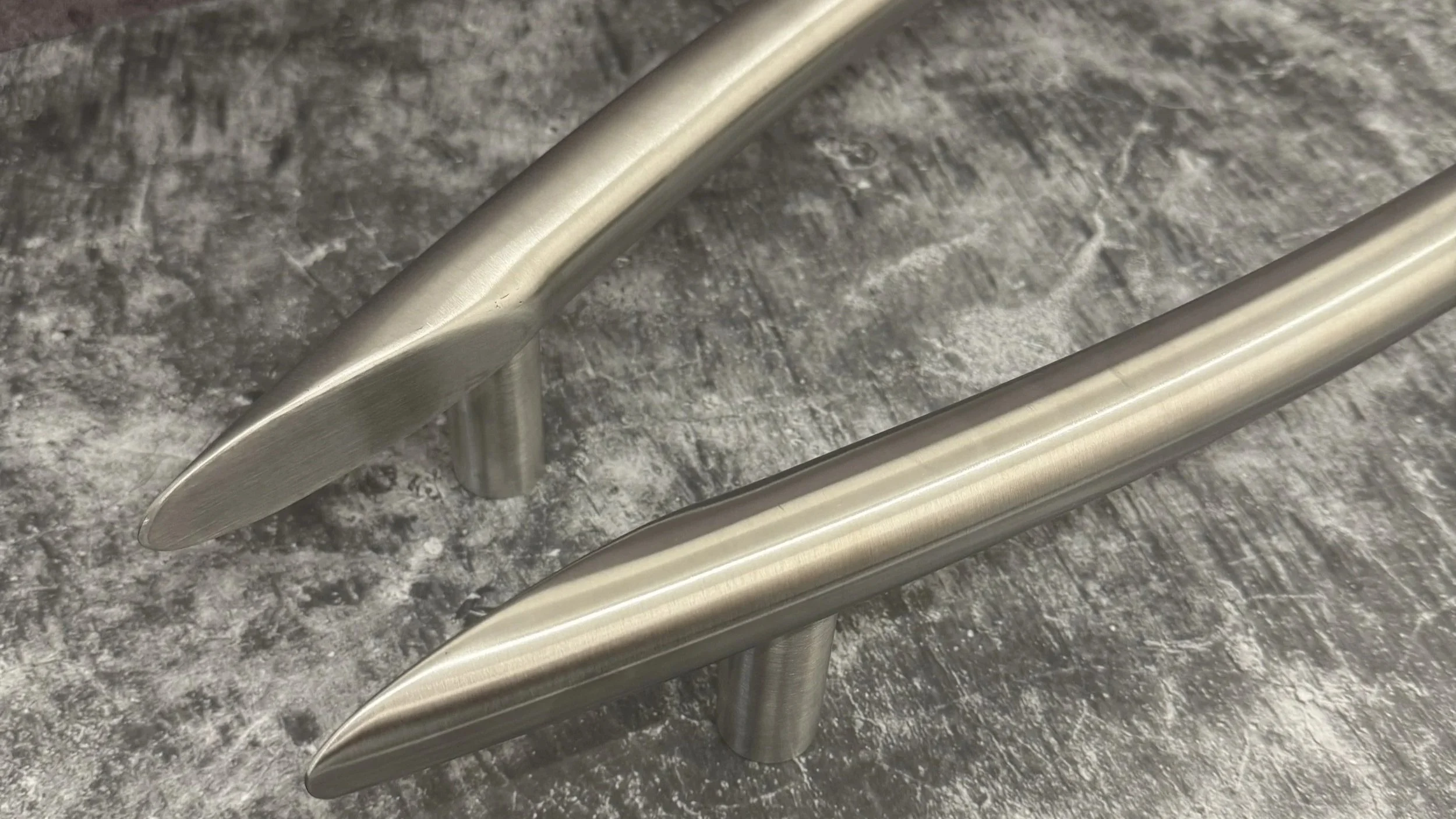
A pull handle has to be reachable and easy to grip for someone with limited hand strength or a weak grasp. Its height, its projection from the door and the section your hand closes around all decide whether it is comfortable or a struggle. A push plate has to take a shoulder, a trolley or a wheelchair footplate without flexing or working loose. Operation should never demand a tight grasp or an awkward twist of the wrist.
These are not finishing details. They are decisions that belong on the schedule next to the standards, because they determine whether the building is usable by the widest range of people.
STRENGTH AND USABILITY ARE TWO DIFFERENT TESTS
It is easy to assume that a well-made handle is automatically an accessible one. It is not. They are two separate questions.
BS EN 1906 grades the mechanical performance of door furniture. It tells you whether a handle will survive the cycles and the traffic of a busy hotel, with Grade 4 representing the heaviest duty at 200,000 cycles. That is a durability test. Accessibility is a usability test: can a person with reduced strength or dexterity actually operate this, comfortably, every time. A handle can pass one and fail the other. On a hospitality project you need both answers, and you need them before anything is sent for finishing.
BARRIERS, STAIRS AND SIGHTLINES
Accessibility is not only about the doors. A feature stair, a mezzanine or a roof terrace in a hotel needs a barrier that is safe for everyone using it. BS 6180 covers barriers in and around buildings, and Approved Document Part K covers protection from falling, collision and impact. Between them they set the loadings a barrier and its fixings must resist, which rise where crowds gather, and they govern infill so that a small child cannot slip through.
Sightlines matter too. A vision panel lets people see who is coming the other way before a door swings into them, which protects everyone in a busy corridor and especially anyone moving more slowly or carrying something. BS EN 12519 gives the shared terminology for the panel and its surround, while BS EN 12600 classifies the impact performance of the safety glass, which is the glass specifier's responsibility. The surround then has to hold that glazing cleanly and take the daily knocks of circulation.
SPECIFY FOR THE PERSON, MADE TO THE DOOR
The thread running through all of this is the same one we return to often: lead with what the component has to do, then choose how it looks. Accessibility is the clearest case for it. The right handle for an accessible threshold is defined by reach, grip and operation first, and finish last.
This is also where bespoke earns its keep. Because we design and make in Nottingham, the geometry of a handle, its length, projection, section and fixing, can be set to the door and to the person who will use it, rather than pulled from a catalogue and hoped to fit. Where a standard product cannot meet both the durability and the usability case on a particular door, we can work it until it does.
Accessible hardware does not have to look clinical or compromise a luxury interior. Specified properly, it simply works for more people, quietly, which is exactly what good hospitality design should do
If you are working up a hospitality scheme and want the door furniture to meet Part M and reach for BS 8300-2, talk to us early, while the doors are still on paper.
Sources: Approved Document M (Building Regulations, access to and use of buildings); BS 8300-2:2018 (design of an accessible and inclusive built environment, buildings, code of practice), currently under review; BS EN 1906 (mechanical performance of door furniture); BS 6180 (barriers in and around buildings); Approved Document K (protection from falling, collision and impact); BS EN 12519 (door terminology); BS EN 12600 (impact performance of safety glass).