
Material Choices for High-Volume Projects
When you're specifying door hardware for multiple locations, the material decisions you make at the start will determine whether handle one looks identical to handle one hundred at the end.
This isn't about premium versus budget. It's about understanding what consistency actually requires and making informed choices before production begins.
Here's what we've learned from decades of volume manufacturing.
Why material consistency matters more than you think
For a single installation, minor material variations are invisible. Slightly different grain patterns in brass. Subtle differences in how stainless steel accepts a brushed finish. Nobody notices because there's nothing to compare against.
For volume projects, these variations become obvious. Install handles from different material batches across multiple locations and you'll see differences. Maybe not dramatically different, but noticeably different. Different enough that someone will ask why the Leeds handles don't quite match the Manchester ones.
The problem compounds over time. Materials from different sources age differently. That slight variation on installation day becomes a pronounced difference after two years of use.
Consistency starts with material sourcing, not quality control at the end.
Stainless steel: not all grades are equal
Most people know stainless steel resists corrosion. Fewer people understand that different grades resist corrosion differently, and the difference matters in demanding environments.
Grade 304 stainless is the standard for most applications. Good corrosion resistance, works well in typical commercial environments, more cost-effective than higher grades.
Grade 316 stainless contains molybdenum, which significantly improves resistance to chlorides and salt. This matters in coastal locations, near swimming pools, in environments with de-icing salts, or anywhere chlorine-based cleaning products are used regularly.
The price difference between 304 and 316 is meaningful. But so is the difference between handles that perform for fifteen years and handles that show tea staining within eighteen months.
For volume projects, the grade decision affects every single handle. Getting it wrong is expensive to fix.
Brass: alloy composition and finish implications
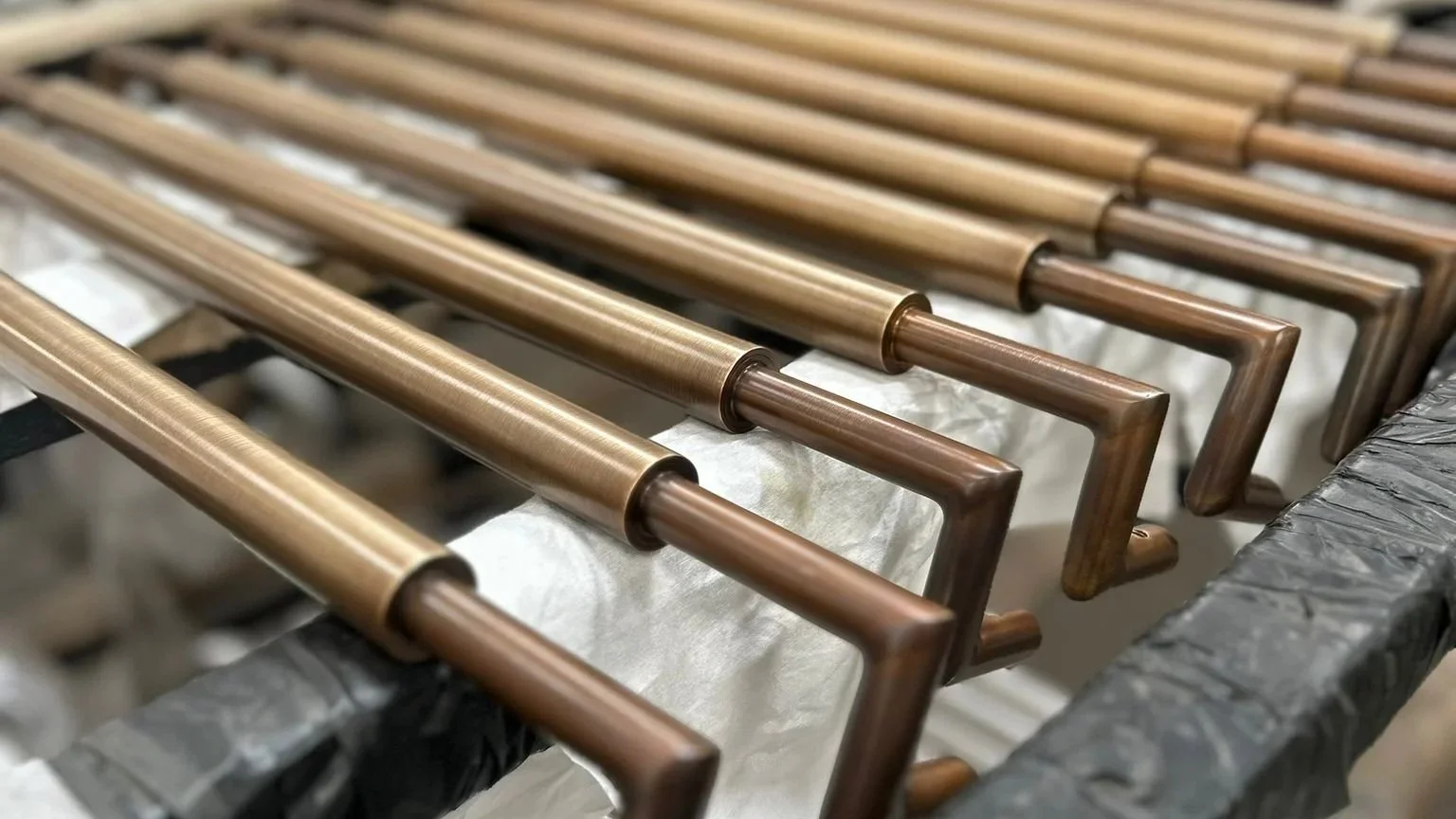
Solid brass remains popular for premium applications. The weight feels substantial, the material ages gracefully, and it takes finishes that cheaper alternatives can't match.
But brass alloys vary. Different compositions affect how the material machines, how it accepts finishes, and how those finishes age over time.
For volume work, alloy consistency is essential. We source complete material requirements for volume projects from single batches wherever possible. Same supplier, same production run, same composition throughout.
This approach costs more upfront. It requires forecasting material needs accurately and committing to quantities before manufacturing begins. But it eliminates the variation that makes volume projects look inconsistent.
The sourcing conversation you should have early
If you're specifying hardware for a volume project, have the material conversation with your manufacturer before anything else.
Ask how they source materials for large orders. Ask whether they can guarantee batch consistency across a phased delivery schedule. Ask what happens if material runs out mid-project.
Manufacturers who take volume consistency seriously will have clear answers. They'll explain their sourcing approach, their quality verification processes, and how they handle the complications that inevitably arise.
Manufacturers who don't take it seriously will talk about quality control instead. Quality control catches problems after they've occurred. Proper sourcing prevents them from occurring in the first place.
What to specify and when
Lock down material specifications during design phase, not procurement. Waiting until tender stage limits options and creates pressure to accept "equivalent" products that may not deliver equivalent results.
Be specific about grade requirements. "Stainless steel" is not a specification. "316 marine grade stainless steel" is a specification.
Consider the environment honestly. If there's any doubt about whether standard grades will perform, specify higher. The cost difference is minimal compared to replacement costs later.
For volume projects spanning months, discuss material sourcing explicitly. How will consistency be maintained across the production timeline? What verification happens between batches?
The real cost calculation
Material choices affect total cost of ownership, not just purchase price.
Higher-grade materials cost more initially but last longer in demanding environments. Proper sourcing for volume work costs more upfront but prevents inconsistency that damages brand perception across locations.
The handles we make are designed to perform for ten, fifteen, twenty years. Spreading that cost over the actual lifecycle changes the calculation significantly.
When someone asks whether they really need marine grade stainless or single-batch brass sourcing, the answer depends on whether they're optimising for purchase price or total cost.
We know which calculation makes more sense.