
WHO ACTUALLY TOUCHES A BESPOKE DOOR HANDLE BEFORE IT LEAVES THE FACTORY?
More people than the schedule suggests, and every one of them makes a decision that shows up on the door.
It starts with whoever reads the drawing. In our case that is usually one of the family, because I have been taking specification calls for twenty-three years and I still like to see what is coming in. This is the person who notices that the fixing centres do not match the stated overall length, that the door is 60mm thick where the fixings were priced for 44mm, or that a pair of cranked pulls has been ordered as two of the same hand. Most expensive mistakes in door hardware are caught, or missed, at this desk.
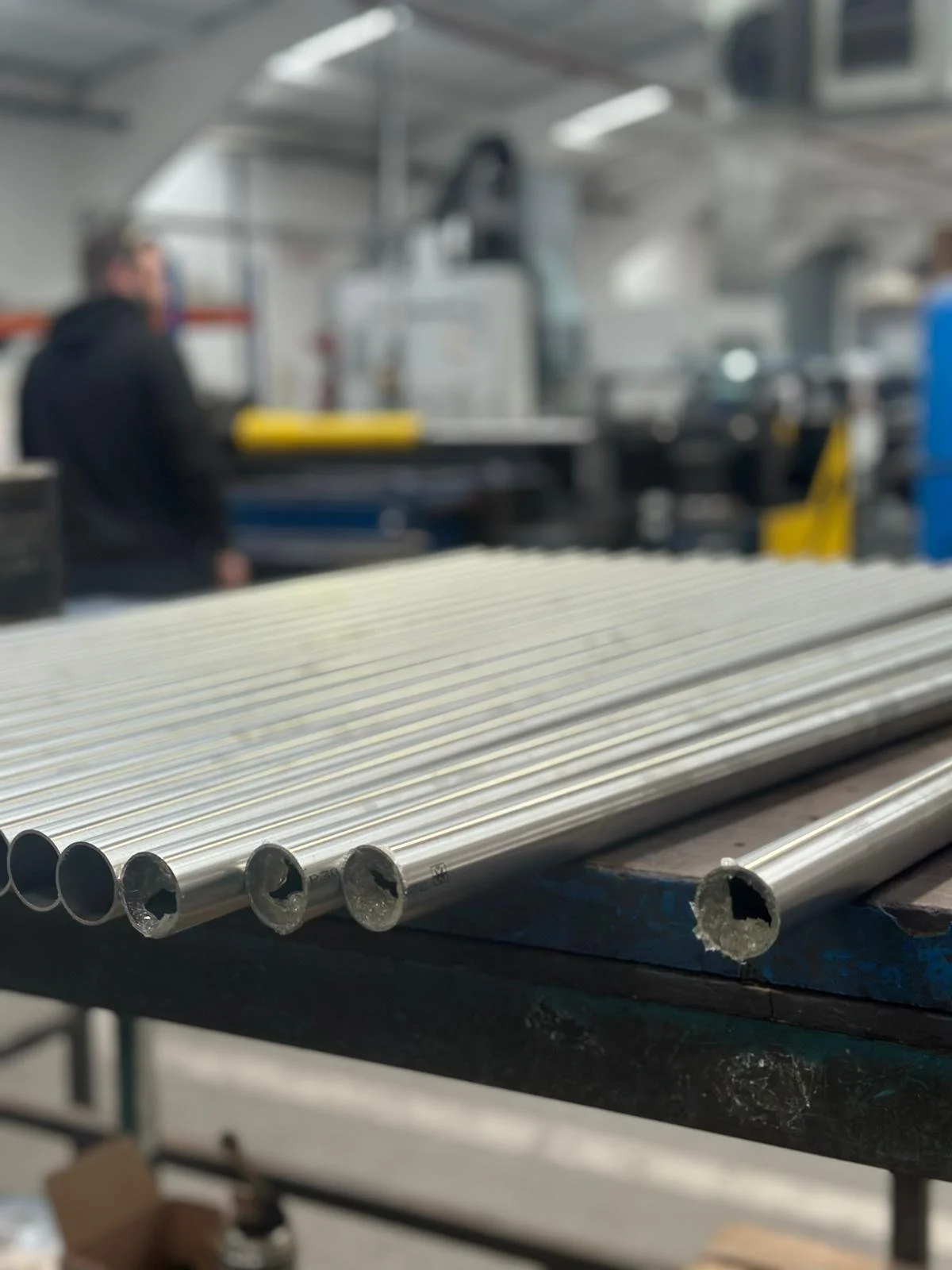
Then the drawing becomes a workshop drawing, dimensioned properly and sent back for sign-off. Only after that does material get cut. The machinist turns bar into geometry: grip section, radii, fixing holes, the crank on an offset pull. A good machinist reads a drawing the way a good editor reads a sentence, looking for the thing that cannot be right.
Next comes the finisher, who deserves a section of their own. Then whoever checks the piece against the approved sample, and finally the person who packs it, labels it by opening and makes sure a hand-finished pull arrives on site looking exactly as it left the bench. Five or six pairs of hands for one handle. Multiply that by a hotel and you begin to see why the people matter.
WHAT DOES A HAND FINISHER DO THAT A MACHINE CANNOT?
A hand finisher decides when a surface is finished, and no machine has yet learned to do that.
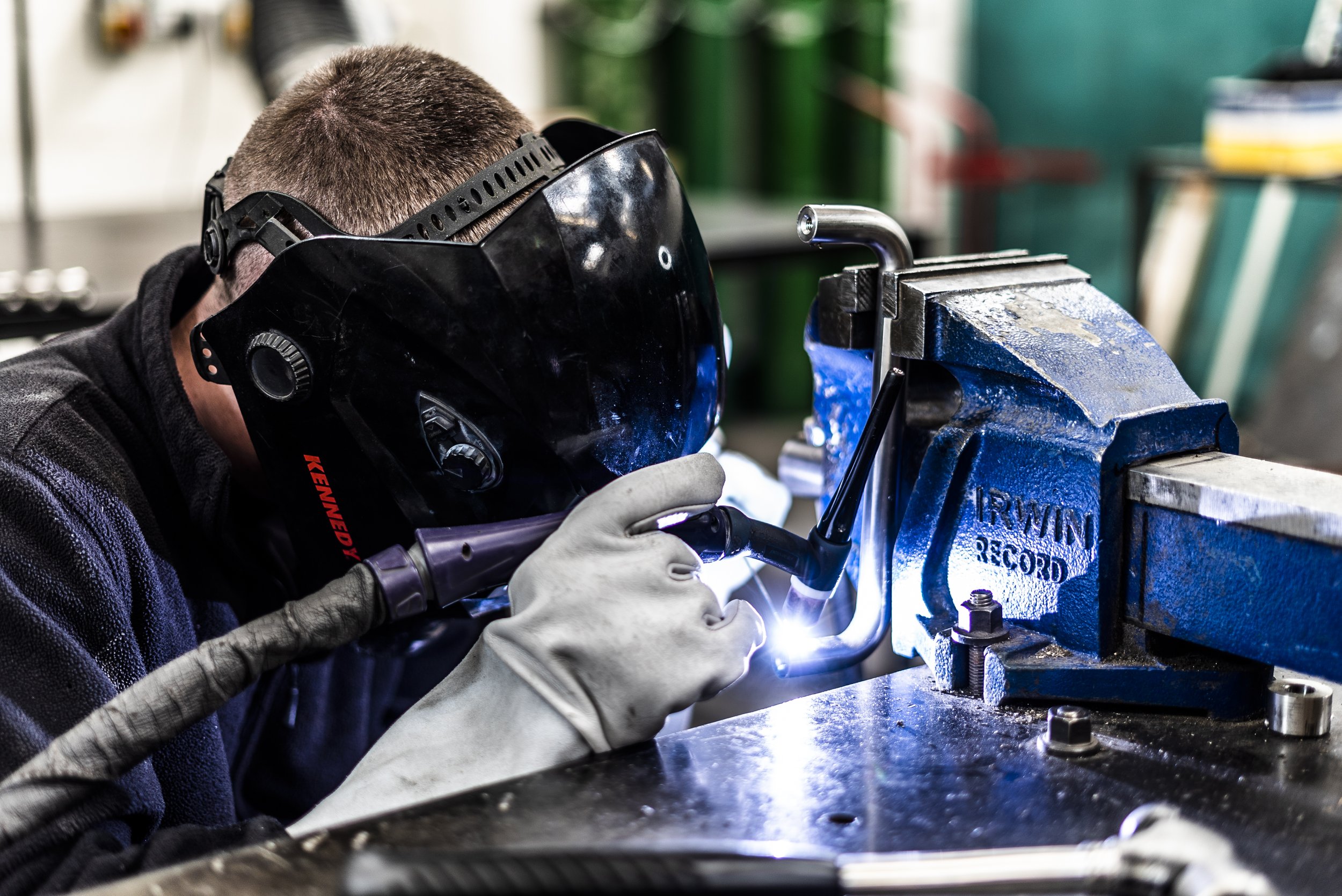
Machines are marvellous at repetition. They will hold a tolerance all day and never get bored. What they cannot do is look at a satin brass surface under a north-facing window and know that it is a shade too bright against the approved sample, or feel with a thumb that an eased edge has lost its crispness. That judgement is the whole point of a hand-applied finish, and it is why we insist on a signed-off sample before any finishing begins. The sample gives the finisher a target that cannot be argued with.
The finisher also knows things that never appear on a data sheet: how brass behaves at the end of a long bar, how polished stainless shows every pass if you rush the last one. Our finishes are corrosion tested to CDP Silver Type 2 and every product has its own data sheet, and I am proud of both, but the test result tells you the finish will last. The finisher is the reason it looks right on day one.
HOW ARE THESE SKILLS PASSED ON IN A SMALL BRITISH FACTORY?
Slowly, deliberately, and by standing next to somebody who already has them.
You can film a finisher at work and still not know what they were looking for. The skill passes one way only: an experienced pair of hands beside a younger pair, saying again, until the younger hands stop needing to be told.
That costs a manufacturer time, and not every business chooses to spend it. Make UK reported earlier this year that apprenticeship starts in manufacturing and engineering have fallen by 40% since the levy was introduced in 2017, with around 50,000 live vacancies across the sector. Read that as a specifier and it means something quite practical. The judgement you rely on when you write "finish to approved sample" is becoming rarer, and it lives in specific factories rather than in the industry at large. We have made our choice on that, and we keep making it every week the order book argues otherwise.
WHY DOES IT MATTER TO SPECIFIERS WHO MADE THE HARDWARE?
Because consistency, repeatability and honest advice all come from people, not from a product code.
A handle made this year should match one made three years ago, and it will if the same judgement made both. We make to drawings and we keep them, so when a hotel rings about matching pulls we supplied long ago, the answer is a file, not a shrug. And the person who tells you that half your schedule does not need bespoke, or that your brass will age unless you ask for it to be held, is a person, usually one who has watched the consequences of the other answer.
A distributor sells you what is in the box. A manufacturer sells you the people who made it. Both are legitimate purchases. Schedules rarely say which one they assume.
WHAT SHOULD YOU ASK A DOOR HARDWARE MANUFACTURER ABOUT ITS PEOPLE?
Ask who reads your drawing, who applies the finish, and whether you can meet them.
The simplest test is a factory visit. If a supplier cannot walk you along the bench your handle will be made on, it is worth asking why. Beyond that, ask whether finishes are applied in-house and to what reference, whether the drawing is kept afterwards, and who answers the phone when a site manager rings in the last fortnight before an opening, because that call is coming.
Our factory in Nottingham is easy to find and the kettle is generally on. Bring a live project if you have one. An hour at the bench answers most of these questions faster than this article can.
FREQUENTLY ASKED QUESTIONS
What is the difference between a door hardware manufacturer and a distributor?
A manufacturer makes the product, usually to a drawing, in its own factory, and can change geometry, length, fixing centres and finish to suit the door. A distributor stocks and sells products made elsewhere, so the product in the box is fixed. Both have their place; bespoke or non-standard doors generally need a manufacturer.
What does hand finished mean on a door handle?
It means the final surface, whether satin, polished or a bespoke tone, is applied and judged by a skilled person against an approved physical sample rather than left as it came off the machine. The sample is the reference the whole order is checked against.
Can I visit a door hardware factory before specifying?
Yes. Ash Door Furniture welcomes architects, interior designers, contractors and students to its factory in Nottingham. A visit lets you see finishes being applied and discuss a live project with the people who will make the hardware.